Public Key (SPKI Format / PEM)
Web Crypto Key and Pair Generator
100% client-side cryptographic key utility. Generate RSA-PSS, ECDSA, and Ed25519 pairs or AES symmetric keys with instant JWK export.
Algorithm Parameters
Private Key (PKCS8 Format / PEM)
What is This Tool
This web-native compiler provides instant generation of high-entropy cryptographic keys and asymmetric key pairs without trusting external systems. Built explicitly to eliminate dangerous command-line configuration slip-ups, it provisions complex RSA parameters, fine-tuned Elliptic Curves (ECC), and symmetric enterprise block ciphers directly inside your browser sandbox. It bridges the gap between complicated open-source terminal commands and non-technical workflows by matching native performance with instant output visibility.
By relying exclusively on client-side hardware entropy engines, the engine bypasses traditional cloud-based generation pipelines which are prone to network packet sniffing or system log recording. Developers, security analysts, and system administrators can immediately configure exact token criteria to produce clean, copy-paste-ready PKCS#8, SPKI, and Raw hex strings for app deployment, identity verification setups, or test environments.
Suited For Your Role:
How to Use
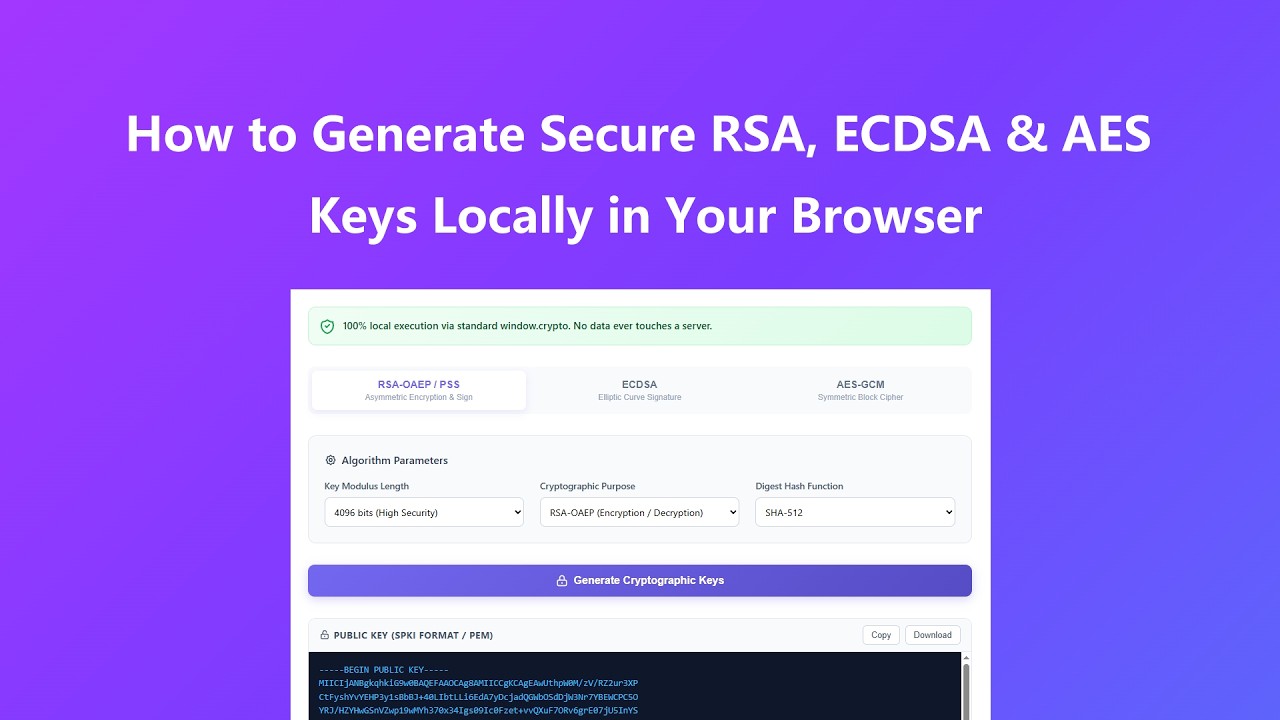
Provisioning secure deployment ready values requires minimal friction inside this interactive control terminal:
- Toggle between core tabs—RSA-OAEP/PSS, ECDSA, or AES-GCM—to load the exact mathematical layout needed for your target application.
- Modify parameter granularities such as RSA modulus bit-widths (up to 4096-bit), Elliptic Curve name weights, or SHA digest hashes via contextual drop-down choices.
- Trigger the generation process using the unified execution button to execute asynchronous hardware-level entropy mapping.
- Examine raw blocks, copy individual string payloads instantly via targeted click commands, or save individual keys directly as structured PEM files.
Key Features
- SubtleCrypto hardware acceleration harnesses built-in system entropy for millisecond execution speeds that outpace legacy script libraries.
- Full-scale asymmetric and symmetric specification grids let you select complex layouts ranging from Web3-ready ECC curves to classic RSA setups.
- Standard PEM wrapping accurately formats exported structures into standard headers for drop-in compatibility with Linux daemons and config files.
- Absolute zero-server architecture restricts all cryptographic processing to physical device RAM, neutralizing remote ingestion hooks.
- Adaptive container rendering formats complex Base64 parameters beautifully across mobile displays, avoiding display truncation issues.
Common Use Cases
- Staging isolated testing environments for local API authentication schemes or mock JSON Web Token (JWT) workflows.
- Provisioning reliable ad-hoc asymmetric parameter matrices for SSH config updates and server access controls.
- Securing config files with precise symmetrical key seeds before deploying infrastructure changes to public cloud systems.
- Validating client-side cross-browser encryption logic configurations without introducing production keys to third-party test sites.
- Creating temporary verification certificates for specific dev staging environments and enterprise software integrations.
Frequently Asked Questions
How can I verify that my generated private keys are genuinely safe from external interception?
The system utilizes the Web Crypto Web API natively integrated into your local engine. You can safely disconnect your device from the internet entirely, pull up your system inspector tools, and execute calculations fully offline. No data packages are built, cached, or transferred over the web.
Why does this client generator export RSA keys using SPKI and PKCS#8 structures?
These specific formatting standards guarantee complete, universal compatibility across production environments like OpenSSL, Java Keystores, and Node.js crypto architectures. They eliminate common character encoding bugs when copying values into terminal instances.
Can I use these specific Elliptic Curve configurations to manage production Web3 or blockchain identities?
This utility provisions standard NIST-approved curves like P-256 and P-384. While highly secure for standard web apps and web service validation patterns, specialized decentralized ledgers frequently rely on alternative configurations like secp256k1, which require different math structures.
What causes symmetric AES-GCM output to appear as a short, uniform hex string compared to RSA keys?
Symmetric configurations rely on a single shared secret token instead of complex mathematical pairs. A 256-bit key translates cleanly into a raw 64-character hexadecimal array, which is perfectly optimized for environment variable records.
Does this setup allow me to re-import existing PEM blocks to check their specific parameters?
No, this tool acts as an isolated, forward-only generator to maintain a clean operational scope. It purposefully avoids handling external key ingestion to prevent accidental data leaks or cross-contamination from untrusted files.
Advanced Tips
Maximize your cryptographic development setup efficiency with these direct engineering practices:
- Pair your generated 4096-bit RSA keys with automated production workflows using local environment variables rather than hardcoding blocks inside raw source code repositories.
- Utilize the downloadable PEM files directly inside your command line setups by updating local file access privileges via standard unix commands to keep key files secure.
- Choose the modern P-384 or P-521 elliptic curves when building high-performance mobile APIs to minimize network payload weights while maintaining strong security margins.
- Double-check that your development teams align on identical digest parameters like SHA-256 when deploying RSA padding to prevent decryption issues between separate platforms.