ROI Calculator
Free online ROI calculator to measure return on investment accurately. Calculate profit, loss and investment percentage for business and financial planning in seconds.
Enter your investment details below to instantly calculate your ROI percentage, net profit or loss, annualized return, and investment multiple. All calculations happen right in your browser.
ROI Calculation Results
Return On Investment Formula Explained
ROI (Return on Investment) is a key financial metric used to evaluate the profitability of an investment. The core formula for ROI is: (Net Profit / Total Investment Cost) × 100 = ROI Percentage.
Net Profit is calculated as Final Investment Value minus Initial Investment and any Additional Costs. This percentage represents the gain or loss generated on an investment relative to the amount invested.
Annualized ROI adjusts the standard ROI to account for the investment period, calculated using the formula: [(Final Value / Total Cost)^(1/Period) - 1] × 100. This metric is critical for comparing investments with different timeframes.
Investment Multiple (MOIC) shows how many times over you got your money back by dividing Final Investment Value by Total Investment Cost. A multiple of 1.00x means you broke even, while 2.00x means your investment doubled.
A positive ROI indicates a profitable investment, while a negative ROI means the investment resulted in a loss. Higher ROI percentages signify more efficient use of capital and better investment performance.
What is This Tool
The Advanced ROI Calculator is a precise financial instrument designed to measure corporate and personal capital efficiency across various holding periods. By evaluating initial capital expenditures against realized ending values and incorporating secondary friction costs, this platform delivers institutional-grade analytics for multi-asset comparison.
Unlike standard calculators that fail to normalize asset velocity over time, this mechanism automates temporal adjustments, enabling accurate benchmarking between disparate financial products. The algorithmic backend computes both absolute yield velocities and standardized annual performance structures without requiring recursive manual scripting.
Engineered to align with modern portfolio theory and commercial real estate analytics, the tool processes dual-layer cost models. It provides users with clear structural insights into cash-on-cash metrics, systemic net cash flows, and time-weighted performance indicators critical for strategic capital allocation.
How to Use
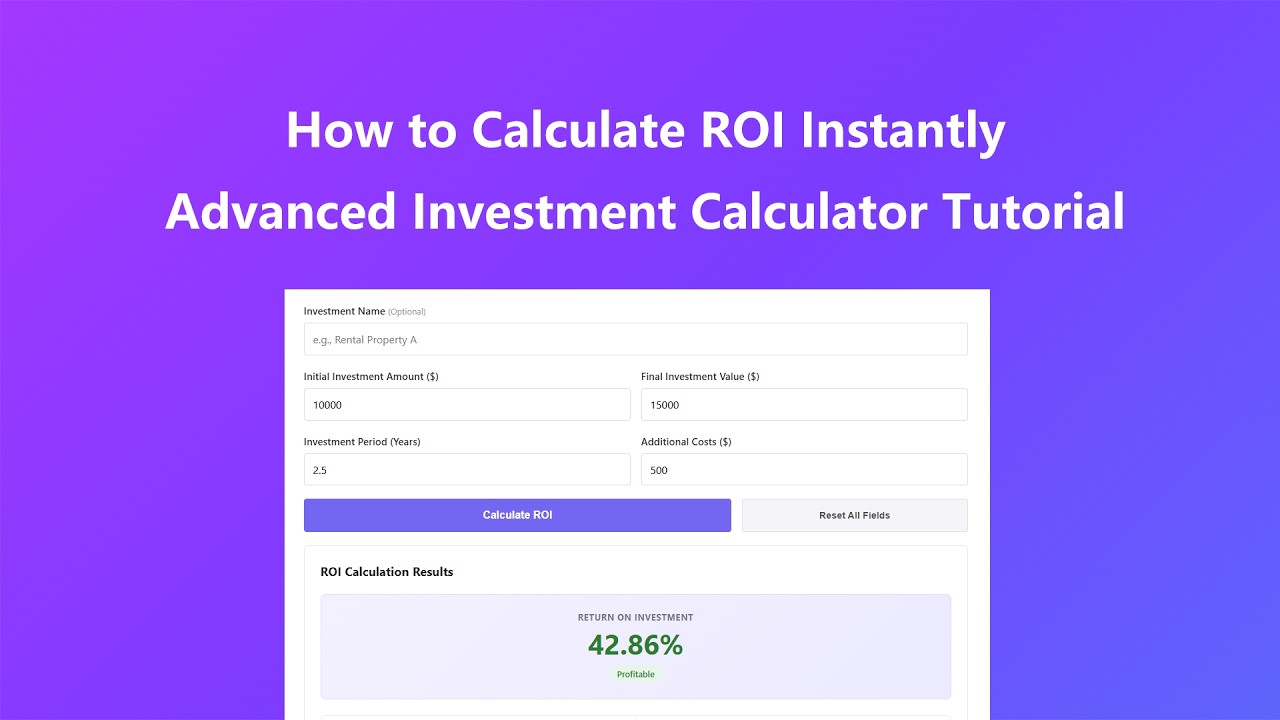
- Define Principal Capital - Input the raw acquisition expense or initial cash outlay required to establish the structural position, accounting for baseline asset valuation.
- Capture Liquidation Value - Input the gross terminal value or current fair market equity realized at the conclusion of the specified holding timeframe.
- Establish Temporal Parameters - Input the exact duration of the asset lifecycle in annualized decimal form to enable accurate compound growth distribution scaling.
- Account for Ancillary Drag - Consolidate all transactional overhead, structural maintenance fees, and capital improvements into the secondary cost input module.
- Execute Performance Parsing - Trigger the core calculation interface to populate your absolute cash flow distributions, CAGR variations, and annualized margin parameters.
- Flush Configuration Matrix - Utilize the master initialization array to clear working computational registers and configure alternative analytical financial models instantly.
Key Features
- Dual-Vector Temporal Analytics - Generates both standardized geometric compound growth metrics and simple straight-line annualized allocations for comprehensive duration mapping.
- High-Resolution Numeric Parsing - Handles variable decimal inputs for fractional holding periods and explicit cent structures, eliminating compounding estimation variances.
- Instantaneous State Rendering - Leverages localized client-side computational logic to provide sub-millisecond execution patterns without triggering external server cycles.
- Asymmetric Value Boundary Validation - Features specialized logic routines designed to handle complete principal impairments and negative performance vectors securely.
- Adaptive Layout Architecture - Utilizes a completely responsive styling layout that scales across standard high-resolution workspaces and compact mobileview frames.
- Synchronized State Initialization - Features an integrated structural reset pipeline that completely clears active memory buffers without requiring document reloads.
Common Use Cases
- Equities Performance Benchmarking - Analyze annualized returns for public equities positions, correcting for initial trade premium commissions and subsequent maintenance costs.
- Capital Expenditure Assessment - Evaluate long-term commercial equipment acquisitions by cross-referencing operational production yields against structural acquisition costs.
- Real Estate Capital Mapping - Model specific fix-and-flip or multi-family rental asset yields while accounting for closing overhead and structural rehabilitation inputs.
- Venture Funding Allocations - Track early-stage startup capital deployments against enterprise round step-ups over variable multi-year developmental windows.
- Marketing Campaign Efficiency - Audit advertising customer acquisition expenditures against long-term operational pipeline revenues generated during specific quarters.
Frequently Asked Questions
What is considered a good ROI percentage?
A "good" ROI varies by industry and investment type, but generally, a positive ROI above the risk-free rate (e.g., government bonds) is considered favorable. For most investments, an ROI of 10% or higher is viewed as strong, while real estate investments often target 8-12% ROI.
Why is annualized ROI important?
Annualized ROI standardizes returns across different investment periods, making it possible to compare investments with varying timeframes. For example, a 20% ROI over 5 years is very different from a 20% ROI over 1 year, and annualization provides an apples-to-apples comparison.
Should I include taxes in my ROI calculation?
Yes, for accurate real-world results, taxes should be included as additional costs in your calculation. This provides a net ROI figure that reflects the actual return you'll receive after tax obligations are met.
Can this calculator handle negative ROI values?
Absolutely. If your final investment value is less than your total costs, the calculator will display a negative ROI percentage and net loss, clearly indicating an unprofitable investment.
Is the ROI calculator suitable for short-term investments?
Yes, the tool works for any investment period, from short-term (days or months) to long-term (decades). The investment period field accepts decimal values, allowing precise calculation for investments held for less than one year.
How often should I calculate ROI for my investments?
For active investors, quarterly ROI calculations help track performance and identify underperforming assets early. Long-term investors may calculate ROI annually or semi-annually to monitor progress toward financial goals.
Advanced Tips
- Isolate Pure Compounding Performance - Analyze the distinction between CAGR representations and baseline straight-line models to uncover hidden performance disparities.
- Incorporate Asset Friction Baselines - Factor in legal administrative fees and transactional clearing metrics under secondary costs to capture absolute real yields.
- Monitor Performance Compression - Track historic annualized curves across uniform asset types to systematically spot yield dilution patterns early.
- Run Pro-Forma Projections - Feed prospective future valuation models into the terminal input module to build structured milestone targets before capital deployment.
- Discount Nominal Returns - Deduct current inflationary indices from calculated terminal percentage arrays to isolate authentic purchasing power shifts.
- Segment Multi-Phase Injections - Evaluate multi-tiered venture investments independently by parsing localized duration metrics across distinct operational steps.