Color Blind Test
Take a quick and reliable online color blind test using professional Ishihara plates to check for red-green or total color vision deficiency.
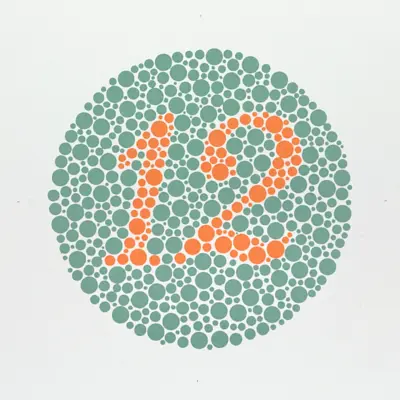
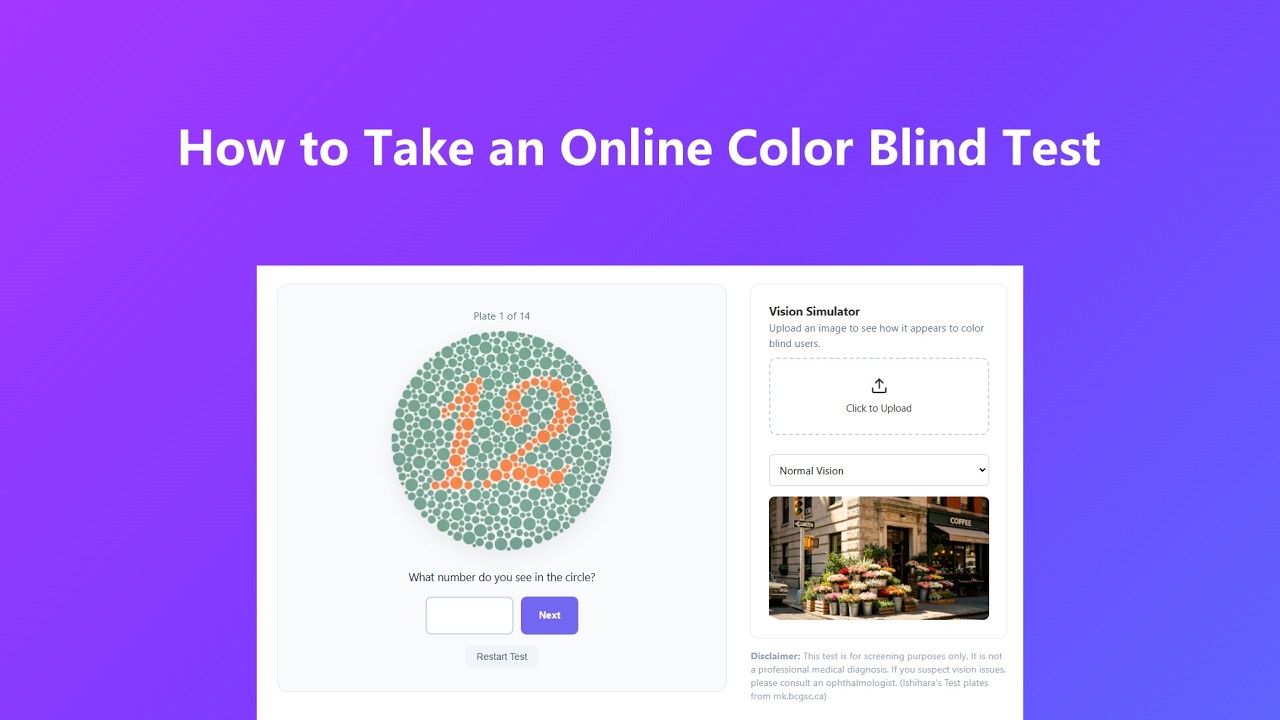
What number do you see in the circle?
Vision Simulator
Upload an image to see how it appears to color blind users.
Click to Upload
Disclaimer: This test is for screening purposes only. It is not a professional medical diagnosis. If you suspect vision issues, please consult an ophthalmologist. (Ishihara's Test plates from mk.bcgsc.ca)
What is This Tool
The Color Blind Test: Online Ishihara Edition is a comprehensive vision screening suite designed to identify color vision deficiencies (CVD) with scientific accuracy. Based on the gold-standard Ishihara pseudoisochromatic plates, this tool presents a series of specialized dot patterns where numbers or shapes are hidden within varying color contrasts. It is optimized to detect the most common forms of color blindness, specifically Protanopia and Deuteranopia (red-green deficiency).
Beyond simple screening, this tool integrates a professional Accessibility Simulator. This feature allows UI/UX designers, artists, and developers to upload their work and visualize it through the eyes of individuals with different types of color blindness. By merging medical-grade testing with functional design utility, we provide a holistic solution for both personal health awareness and digital accessibility compliance.
How to Use
- Standardize Your Environment - Ensure your screen brightness is set to 100% and disable any "Blue Light Filter" or "Night Shift" modes that might distort colors.
- Begin the Ishihara Sequence - Observe the first plate provided in the center box; look for a number or path formed by specific colored dots.
- Input Your Observations - Type the number you see into the input field and click "Next." If you see nothing, leave it blank or enter a "0".
- Complete the Screening - Go through the full sequence of plates without rushing. Consistency across the test is vital for an accurate assessment.
- Analyze Your Results - Upon completion, the tool will categorize your vision as Normal, Red-Green Deficient, or Total Color Blind based on your response accuracy.
- Simulate Design Assets - Use the side panel to upload website mockups or logos to verify if important information remains distinguishable for color-blind users.
Key Features
- Scientific Ishihara Methodology - Utilizes a curated sequence of high-fidelity plates that target the specific retinal cone sensitivities.
- Interactive Deficiency Simulator - Advanced image processing engine that re-maps color gamuts to simulate Protan, Deutan, and Achromatopsia vision.
- Instant Diagnostic Feedback - Real-time calculation of results with a clear breakdown of which color spectrums are likely affected.
- Design-Centric Accessibility - Direct support for image uploads, allowing professionals to audit their designs for WCAG color contrast accessibility.
- Privacy-First Processing - All image simulations are performed locally in your browser; your private images or test data are never uploaded to our servers.
- Multi-Device Compatibility - Optimized for both high-resolution desktop monitors and mobile screens, maintaining color accuracy across platforms.
Common Use Cases
- Personal Health Check - A quick and reliable way for individuals to screen themselves or their children for suspected color vision issues.
- UI/UX Design Auditing - Helping designers ensure that call-to-action buttons, charts, and maps are usable for the 8% of men with color deficiency.
- Pre-Employment Screening - Preliminary testing for careers where color perception is critical, such as electrical work, aviation, or graphic design.
- Educational Illustration - Teachers using the tool to demonstrate to students how vision varies between individuals and the importance of inclusive design.
- Digital Accessibility Testing - Developers verifying that web content meets contrast standards without relying solely on color to convey meaning.
Frequently Asked Questions
Can an online test replace a visit to an eye doctor?
No. While our Ishihara plates are accurate, digital screens vary in color calibration. An online test is a screening tool, not a medical diagnosis. Only a qualified optometrist using specialized equipment can provide a definitive result.
What is the most common type of color blindness?
Red-green color blindness is by far the most prevalent, affecting roughly 1 in 12 men and 1 in 200 women of Northern European descent. It includes both Protanomaly and Deuteranomaly.
How does screen brightness affect the test results?
Low brightness or "Night Mode" filters add a yellow/orange tint to the screen, which can lead to false negatives. Always use a clean, bright screen for the most reliable screening.
Can I still use the simulator if I have normal vision?
Absolutely. The simulator is designed specifically for people with normal vision to understand the perspective of color-blind users, making it a vital empathy and design tool.
Is total color blindness (Achromatopsia) rare?
Yes, total color blindness is extremely rare, affecting approximately 1 in 30,000 people. People with this condition see the world entirely in shades of grey, black, and white.
Does this test work for children who can't read numbers yet?
This specific version uses numbers. For young children, pediatricians usually use plates with symbols (circles, squares) or "hidden trails" that the child can trace with their finger.
Advanced Tips
- Monitor Calibration - Use an IPS panel monitor if possible, as they provide better color accuracy and wider viewing angles than standard TN panels.
- Avoid Glare - Perform the test in a room with neutral lighting. Avoid strong sunlight or colored lights reflecting off your screen which can interfere with dot perception.
- Designing with Red/Green - When designing, never rely on red and green alone to signal "Stop/Go" or "Error/Success." Always add icons or text labels for clarity.
- Color Palette Selection - Use "Color-Blind Friendly" palettes (like those provided by Adobe Color or ColorBrewer) for data visualization to ensure universal readability.
- Distance Matters - Sit approximately 75cm (30 inches) away from the screen to ensure the dot patterns are perceived as a cohesive group rather than individual pixels.
- Contrast is Key - If you find an image is difficult to read in the simulator, try increasing the brightness contrast or changing the hue of the critical elements.